



98% Polyester 2% Carbon Fiber ESD Anti-Static Conductive Fabric for Workwear Clean Room
We have complete testing instruments and stable, reliable quality of UHMWPE CLOTH Filament, UHMWPE CLOTH, Balsalt Fiber Fabric Product. A well-planned operation plan can link our company's operations with our vision, thereby motivating all employees to work hard to achieve the planned goals. Relying on our core technological competitiveness and resource advantages, we actively carry out cooperation and exchange with related enterprises. We take the pursuit of high-tech and high-quality brands as the main business philosophy, and the business goal of combining the best quality products with reasonable prices. We sincerely welcome domestic and foreign merchants to visit, order and negotiate business.
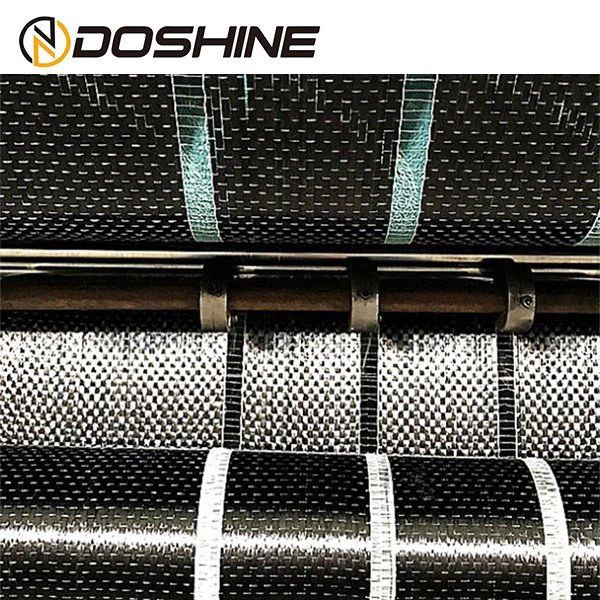
Carbon fiber woven fabric is used as reinforcing materials for civil engineering products, and as materials for sporting applications, including bicycles, and aircraft components. The range of applications continues to expand.
Carbon fibers is a key ingredient in advanced composite materials. They are bidirectional weave. These fibers are strong and stiff and have a high specific strength when combined with a matrix material (epoxy resin). It is the combination of high strength, high stiffness, extremely light weight , unaffected by high temperature /fuels/oils , anticorrosion, and low density that creates a product that is a higher composite material.
The two most common types of weaves are "plain weave" and "twill" in different yarn (1k,3k,6k). Plain weave is a balanced checker board pattern, where each strand goes over then under each strand in the opposite direction. Whereas a twill weave looks like a wicker basket. Here, each strand goes over one opposing strand, then under two.
Both twill and plain weaves have an equal amount of carbon fiber going each direction, and their strengths will be very similar. The difference is primarily an aesthetic appearance.
Basic data:
CODE | FIBER TYPE | WEAVING | DENSITY | WIDTH | THICKNESS | GRAM | ||
WARP | WEFT | WARP | WEFT | |||||
1K-CP120 | 1K | 1K | Plain | 9 | 9 | 100-3000 | 0.19 | 120 |
1K-CT120 | 1K | 1K | Twill | 9 | 9 | 100-3000 | 0.19 | 120 |
3K-CP200 | 3K | 3K | Plain | 5 | 5 | 100-3000 | 0.26 | 200 |
3K-CT200 | 3K | 3K | Twill | 5 | 5 | 100-3000 | 0.26 | 200 |
3K-CP240 | 3K | 3K | Plain | 6 | 6 | 100-3000 | 0.32 | 240 |
3K-CT240 | 3K | 3K | Twill | 6 | 6 | 100-3000 | 0.32 | 240 |
6K-CP320 | 6K | 6K | Plain | 4 | 4 | 100-3000 | 0.42 | 320 |
6K-CT320 | 6K | 6K | Twill | 4 | 4 | 100-3000 | 0.42 | 320 |
6K-CP360 | 6K | 6K | Plain | 4.5 | 4.5 | 100-3000 | 0.48 | 360 |
6K-CT360 | 6K | 6K | Twill | 4.5 | 4.5 | 100-3000 | 0.48 | 360 |
12K-CP400 | 12K | 12K | Plain | 2.5 | 2.5 | 100-3000 | 0.53 | 400 |
12K-CT400 | 12K | 12K | Twill | 2.5 | 2.5 | 100-3000 | 0.53 | 400 |
12K-CP480 | 12K | 12K | Plain | 3 | 3 | 100-3000 | 0.64 | 480 |
12K-CT480 | 12K | 12K | Twill | 3 | 3 | 100-3000 | 0.64 | 480 |


We have cultivated a professional technical team and established a high-quality and highly dedicated sales team to make sure that our 98% Polyester 2% Carbon Fiber ESD Anti-Static Conductive Fabric for Workwear Clean Room enjoys the popularity on the market for its performance. We work closely with strategic suppliers to meet our customers' needs for mass production in the shortest possible time, while ensuring that our products are customized to meet their needs. Our company adheres to the service tenet of 'receiving feedback in good faith, providing timely and warm service' and realize zero distance communication with you. Your opinions and suggestions are the driving force for us to move forward.
You Might Also Like


Send Inquiry